Anne Foulkes tells the story of how she discovered the English tradition of West Gallery and how it eventually led her to its American cousin, Sacred Harp.
A little over 20 years ago I moved, with my family, to South East Kent. Romney Marsh is a remote area, sandwiched between the White Cliffs of Dover and the nuclear power station at Dungeness. More sheep live there than people. In the small town of New Romney, we were nearer France than London, and on a clear day we could see the French coast from the bottom of our road.
Having sung in choirs all my life, I was keen to find a singing opportunity in our new home. I can’t remember how I heard about the Marsh Warblers, a West Gallery Quire (choir). They met on the first and third Tuesdays of the month, at Zion Baptist Chapel in the small market town of Tenterden – about 15 miles away. I went along, and so began my West Gallery journey.
I was hooked.
But what is West Gallery?
It was the music popular in town and country churches from around 1700 to 1850, in the days before church organs. Typically, it was performed by amateurs from the local community – artisans, farmers, and tradesmen – who formed bands of singers and instrumentalists. When leading the music for church services, the band sat in the west gallery, at the back of the church. Later, when harmoniums and organs replaced the band, organ pipes were often placed in the gallery. Sadly, very few west galleries survive in churches today.
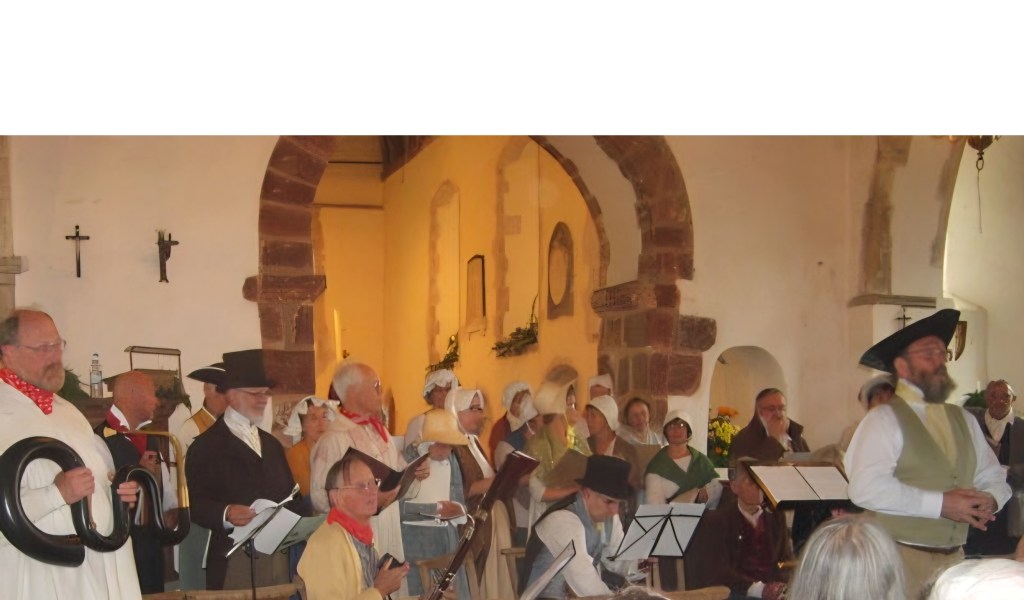
The Marsh Warblers were a costumed quire, not a re-enactment society, but a group paying homage to those who had sung and played this music before us. The band included fiddles, flute, cello, clarinet, bassoon and, if we were very lucky, a serpent. The singers were a motley crew of trebles, altos, tenors and basses. “The tune is in the tenor,” our conductor would often remind us, “be careful not to drown them out!” Those familiar with Sacred Harp may see a link here!
Our concerts recreated, through music and spoken word, the bygone days of the 18th and early 19th centuries, and celebrated the work of local hymn writers, especially the great Thomas Clark of Canterbury. Perhaps most popular, for singers and audiences alike, were our annual “Going the Rounds” Christmas performances. Using text from Thomas Hardy’s Under the Greenwood Tree, we retold the story of the Melstock Band, who sang on Christmas Eve, outside each house in Melstock village, the ancient carols now lost to us.
Carols such as “Shepherds Rejoice”:
No gold or purple swaddling bands,
No royal shining things.
A manger for his cradle stands
And holds the King of Kings.
Or “A Virgin Unspotted”, with the wonderful verse:
But Mary’s full time being come as we find,
She bought forth her first born to save all mankind.
Contented she laid him where oxen did feed,
The great God of nature approved of the deed.
And “Nativity”, better known to most as “While Shepherds Watched their Flocks by Night”. The words of “Nativity” were often sung several times in one concert to a variety of great CM (Common Metre) tunes, which inevitably included “Cranbrook”, better known today as “On Ilkley Moor Baht ’at”. Try it – it works!
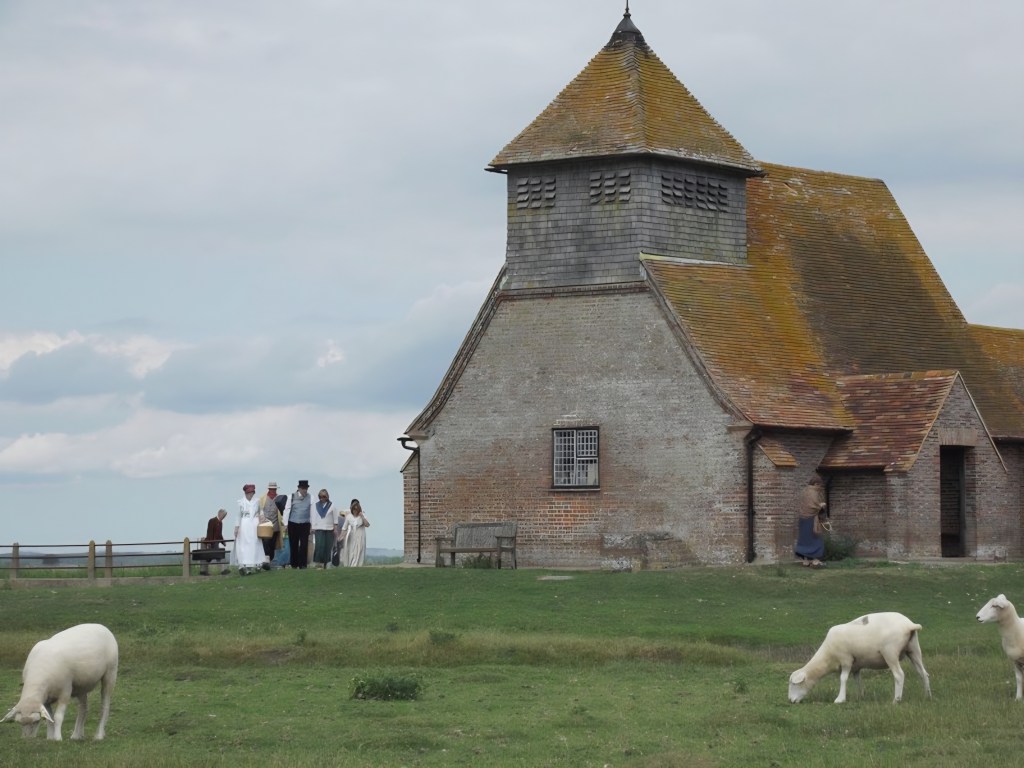
Our annual church crawl, where we were joined by singers from other West Gallery quires, was always a highlight of the year. Four churches visited, two before lunch and two after. We would sing for forty minutes in each church, and what a bonus if there was an actual west gallery for us to sing from! I was never sure what the people in our chosen lunchtime hostelry thought when 40-plus people dressed in 18th-century costumes descended; it was certainly a conversation opener!
All very interesting, but what is the link to Sacred Harp?
Well, when people in the 1800s emigrated to the “New World”, they took their manuscript books with them and sang the familiar songs of home. Many tunes and musical characteristics in today’s Sacred Harp songbooks originated in West Gallery music, carried to America by these settlers.
Its direct influence on Sacred Harp can be clearly seen: four-part tenor-led harmony (ie the tune in the tenor), fuguing tunes and anthems, and specific harmonic structures. Sacred Harp evolved from West Gallery tunes like 273 Milford, 28t Aylesbury, 311 Silver Street, 34b St Thomas, 28b Wells, 84 Amsterdam and the Manchester favourite, 49b Mear. Gradually, these tunes were integrated into a new musical landscape, leading to the creation of new compositions in a similar style. So Sacred Harp continued on its own path, but that’s a different story and another blog post…
Back to Kent and my personal journey. After 15 years happily singing with the Marsh Warblers, we were moving house again, this time to West Yorkshire. I was encouraged to contact the nearest West Gallery Quire to our new home – The Larks of Dean, based in Bury. At my first Larks practice I met Liz, and we rapidly became the “rebel trebles” in the back row. It was Liz who encouraged me to go to a Sacred Harp workshop at the Manchester Folk Festival; the rest, as they say, is history. I joined Manchester Sacred Harp and a whole new musical journey began.
I no longer sing with a West Gallery Quire. But, when we sing 344 Rainbow or 49t Old Hundred, I think of those churches in the Kent countryside. In particular, I remember walking across a field of sheep to the ancient church of St Thomas à Becket at Fairfield, where the music, the instruments and the voices of the “Old Quire” were heard once again.
- Contributor: Anne Foulkes
 Manchester Sacred Harp
Leave a comment